The Clockwork Unwinds
New Life as a Max Level ArchmageThe Clockwork Unwinds is the temporal spell cast by Vivisari Vexaria to restore the grounds of the White Glove Academy after a battle between Titled-strength combatants. Rather than rebuilding the damaged estate through ordinary reconstruction or natural regeneration, Vivisari reverses the local flow of time itself. The act repairs the battlefield down to its smallest displaced fragments, but its success also exposes why temporal magic is treated as forbidden: even a carefully bounded use brings Vivisari close to the limits of her immense power.
Damage That Ordinary Magic Could Not Repair
The spell arises from the scale and character of the destruction surrounding the estate. The fight has not merely torn up a lawn or scattered a few branches. The grounds have become a battlefield marked by toppled trees, enormous cuts in the earth, smoking craters, shattered tiles, misplaced stones, and pulverized turf. The manor survives because the combatants deliberately avoid drawing the conflict toward the building, whose preservation matters chiefly because students remain inside. The surrounding grounds, however, bear the full collateral damage of the confrontation.
Vivisari recognizes that conventional restorative methods are insufficient. Spells such as [Reconstruct] can repair man-made creations, including devices, furniture, buildings, and Convoys, while certain druidic spells can regrow or rejuvenate trees. Neither category can return an entire ravaged landscape to its previous condition. The problem is not one broken object or one injured organism, but a continuous field of destruction in which natural and constructed matter have been violently displaced together.
Construction of the Temporal Working
For the first time since arriving in this world, Vivisari begins casting what the narrative identifies as real magic. The working is immediately distinguished by its overwhelming scale. Mana pours from her in waves so dense that the air appears to thicken, and all five White Gloves stagger and grow pale as they sense the force being committed to the spell. Her control is not expressed through a single dramatic gesture alone, but through an immense act of simultaneous precision.
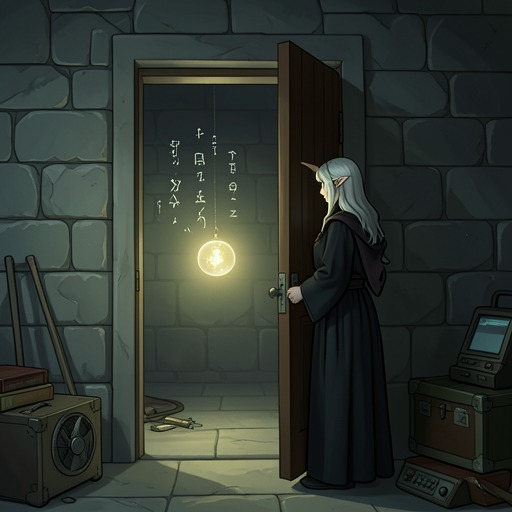
Vivisari employs no fewer than sixty streams of mana at once, painting glowing runes into a spell circle that covers a full third of the expansive estate. The circle dwarfs an ordinary one by an order of magnitude. Hundreds of arcane symbols flow into one another, bleeding power as they settle into a diagram so intricate that even Vivisari struggles to retain its entire structure in her mind. The completed design is presented as something only Vivisari, or perhaps a handful of other people in the world, could have created.
The final count reaches two thousand and sixty-three runes. Their completion produces a grand magical tapestry of such complexity that even an Institute archmage might suffer physically from attempting to look upon it. This detail makes the spell’s function inseparable from its craftsmanship: restoration is achieved not by indiscriminate force, but by an exact reconstruction of the conditions that preceded the battle.
The Forbidden Reversal
Temporal magic belongs to a class of practices regarded as taboo for reasons that range from moral violation to existential danger. Magic that usurps the mind or soul is condemned because it invades the person. Other practices are feared because they interfere with reality’s underlying mechanisms, including tampering with Fate or breaching the dimensional boundary. The danger of Vivisari’s spell lies in the same territory. She reaches toward the fundamental process that carries one minute into the next, the motion that moves the sun across the sky and winter into spring.
Time itself is not described as inherently evil. Like necromancy, temporal magic can exist without moral corruption, and it is not automatically dangerous when used within proper limits. The decisive prohibition concerns sapient creatures. Intelligent minds cannot survive having their temporal continuity violated, and earlier transgressions of that kind helped produce the Shattered Oracle’s madness and unleash his Cataclysms. The spell therefore carries a distinction between changing an environment and violating a living consciousness.
Vivisari keeps within that distinction. She does not target the White Gloves, the students, or any other sapient being. She restricts the spell to the grounds and surrounding areas affected by the duel. Its precision is therefore also an ethical boundary: the battlefield may be returned to an earlier condition, but the people present are not subjected to temporal alteration.
Reality Ticks Backward
After the final rune forms, Vivisari reaches forward and seizes something that should never be seized. She borrows the words of a madman and names the working [The Clockwork Unwinds]. The phrase marks the spell as an intervention in the machinery of reality rather than a conventional healing or repair charm.
The effect begins with a halt. The machinery holding reality together screeches to a stop, then, with agonizing slowness, starts ticking in reverse. Soil and pulverized stone leap from their scattered surroundings and slam back into ragged gouges. Broken turf knits together. Toppled trees shudder upright, while splintered trunks are repaired as thousands of shards slide into their former positions. The restoration is not symbolic or approximate; it reverses the physical consequences of the battle across the targeted grounds.
Within several short moments, the estate’s damaged landscape returns to its former glory. The reversal is visible to everyone present, including Vivisari herself, and the display leaves even her speechless. The spell thus transforms a battlefield into a recovered setting without erasing the fact that the battle occurred. Its extraordinary spectacle is the immediate proof of Vivisari’s power, while the exhaustion that follows prevents that power from appearing effortless.
Cost and Significance
When the spell ends, Vivisari lowers her staff as the link breaks and the conduits carrying mana close. Her legs wobble. She remains far from manaburn, but the effort has approached her limits because it violated one of the universe’s fundamental rules. The consequence is not catastrophic injury, yet it is unmistakable physical strain: even Vivisari cannot cast such magic casually.
The Clockwork Unwinds therefore produces a double movement in the story. On the surface, it restores safety and order around the White Glove Academy, protecting the students from living amid the visible remains of a titanic duel. At a deeper level, it reveals that Vivisari’s greatest abilities are inseparable from restraint. She possesses enough power to manipulate a spell circle spanning a third of an estate and to coordinate sixty mana streams across 2,063 runes, but she must still respect the boundary between an inert landscape and a sapient mind.
The spell’s significance lies in that controlled contradiction. Vivisari touches the mechanism of time, halts reality, and makes it run backward, yet she does so only within a circumscribed region and only to undo environmental damage. The restored grounds become evidence not merely of magical supremacy, but of judgment: the same knowledge that makes temporal magic possible also tells her what must not be changed. In this sense, The Clockwork Unwinds is both a restoration and a warning, an act of near-limitless technical mastery performed under the shadow of the Cataclysms that arose when those limits were ignored.